















DigiGreenTT Group
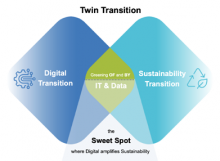
The projects, listed below, make up the initial DigiGreenTT Group and function as an engaging community focused on driving innovation forward in line with the ethos and direction of the European green and digital transition directive. Through a shared-knowledge, understanding and active cooperation approach, collectively, the engaging projects reinforce inclusiveness, impact and sustainability aligned with the priorities of the European Union.
To further support the intention, the DigiGreenTT.eu website has been created.

ST4TE project aims to provide a comprehensive view of the drivers of the twin transition (TT), the inequalities that emerge or are widened by it, and a set of policies to build greener, more equal and more productive societies. The project specifically investigates the impact of the green and digital transitions on inequalities among individuals and territories and explore how existing inequalities affect the TT paths creating cycles of inequalities. Additionally, the project is concerned with the modelling the effects of TT policies, developing forward looking scenarios, and defining pathways for knowledge-based policymaking using tools and recommendations that will ultimately address negative socio-economic effects caused by the TT.
The GreenPaths project addresses the complex and multi-dimensional nature of the just transition. Drawing on an in-depth review of the most relevant research, the project aims to enable more coherent and effective policymaking to advance environmental sustainability and social well-being in Europe and beyond.
The project focuses on three main directions:
- A shift towards a sustainable model of production and consumption,
- A shift towards a social model based on equity and social cohesion, and
- A shift towards greater citizen participation and expanded social dialogue.
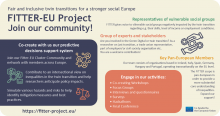
FITTER-EU has strong collaborative ties with the GreenPaths project due to overlapping focus areas. Moreover, some experts are actively involved in both projects - such as Irina Velicu (from The Centre for Social Studies at the University of Coimbra), who serves as a member of the FITTER External Complementary Board while also co-coordinating the GreenPaths project.
Twin Synergies addresses research and innovation disparities across Europe by enhancing skills, fostering international collaboration, and improving policy alignment between national and EU systems. The project supports 'Widening Countries' in building human capital, adopting new technologies, and engaging more effectively with EU funding programs. By strengthening capacities and connections, Twin Synergies aims to enable these regions to participate in the green and digital transitions, promoting sustainable and inclusive growth.
Genesys explores how the transition to clean energy intersects with gender and social inequalities, examining both technical and social dimensions. The project collects and analyses data on participation, access, and decision-making in energy systems to identify barriers and opportunities for under-represented groups. By highlighting these disparities, Genesys aims to guide energy policies and innovations toward a transition that is fair, inclusive, and ensures equal opportunities for everyone to engage with and benefit from the evolving energy landscape. https://zenodo.org/communities/genesys/records?q=&l=list&p=1&s=10&sort=newest
WISE (Women in Solidarity for Energy) focuses on reducing energy vulnerability among 'single' women, including single mothers, elderly women, migrants and students. It raises public awareness of why such women are disproportionately affected. In turn, it hosts local events to boost women's understanding of energy and their energy rights and to co-design solutions that meet their specific needs within a fair and inclusive energy transition. Critically, WISE provides access to practical resources such as the Right to Energy Toolkit (available in 19 languages) and materials to help others join the energy solidarity movement.
TWINRD (Macroeconomic Modelling of R&D for the Twin Transition) aims to strengthen Europe’s macroeconomic modelling capacity to support the intertwined green and digital transition. Building on established models such as GEM-E3 and NEMESIS, the project introduces new data, technology classifications and explicit representations of R&I policies to more accurately reflect green and digital innovation dynamics. Over its three-year duration, a consortium of four research institutes and SMEs with strong expertise in economic modelling and the R&I ecosystem will engage stakeholders in structured dialogues to co-design how twin transition technologies (green and digital) are integrated into enhanced macroeconomic models, co-develop transition scenarios and deliver practical R&I policy recommendations. The project will produce open-source models, datasets and policy-relevant analyses that provide transparent tools to assess socio-economic and environmental impacts of R&I policies and support evidence-based decision-making for a sustainable, digital and inclusive future.
The ESIRA project is formed with the vision that empowering the socio-economic position of rural communities is crucial for sustainable economic development that respects and integrates diverse social structures and the practical needs of marginalized groups. It is focused on implementing innovative socio-economic initiatives, with a focus on developing local social networks in rural communities and improving the economic situation of marginalized groups. The ESIRA project involves mapping marginalized groups in rural areas and implementing innovative initiatives to strengthen their economic and social status. Local initiatives aim to reduce the unemployment rate and the risk of poverty among individuals in marginalized groups, while also increasing their participation in the labor market.

